№ 02 · RCA Document Generator
Real enough to train on. Fake enough to sleep at night.
The Generator produces realistic synthetic Australian documents and records for AI training and evaluation, with zero privacy risk. Every document ships with complete ground truth, so you always know the right answer when you test.
What it generates
Current holdings- 45 medical document types: discharge summaries, ED assessments, pathology and imaging reports, care plans, hospital packs and more.
- 81 internally consistent clinical case archetypes. The medications match the diagnosis. The dates line up. The story holds.
- Commercial insurance packs: broker submissions, policy schedules, loss runs, FNOL forms.
- Red-flag packs: submission packs seeded with deliberate cross-document inconsistencies, recorded in the ground truth, for testing whether your QA process catches them.
From the current libraries
Real generator output · reduced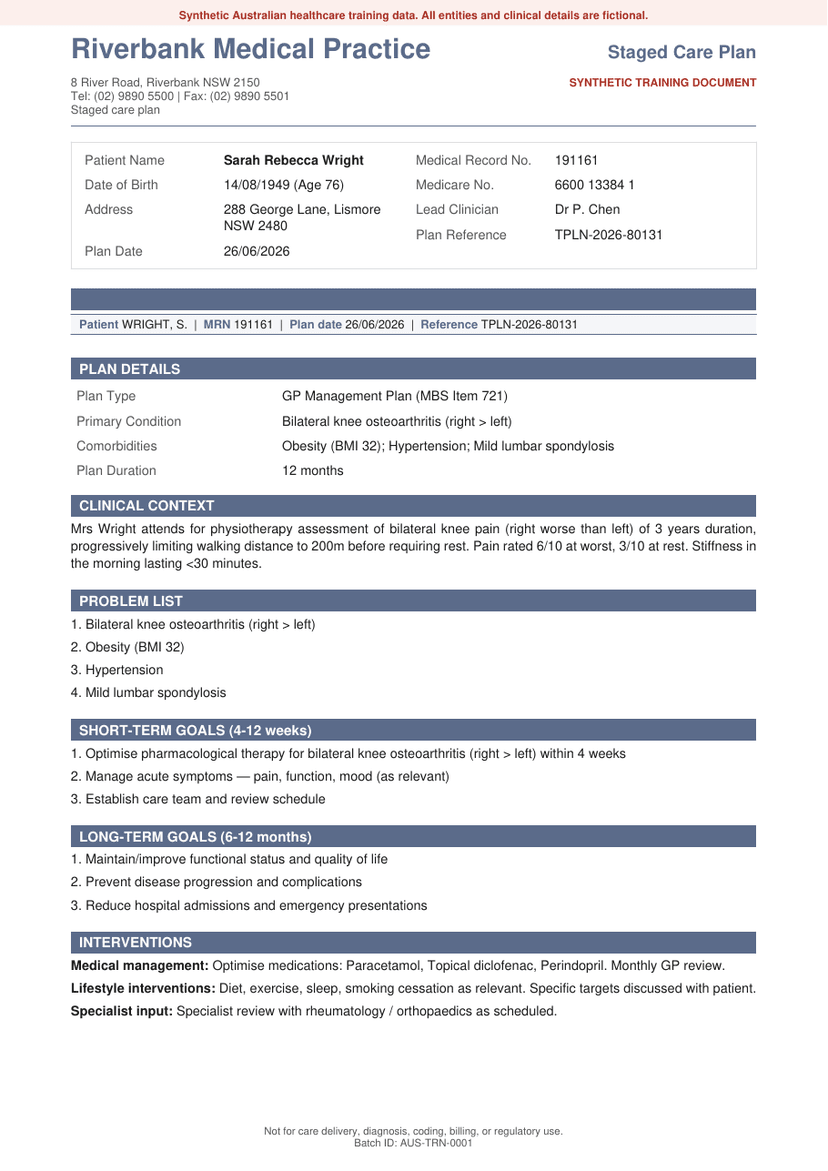
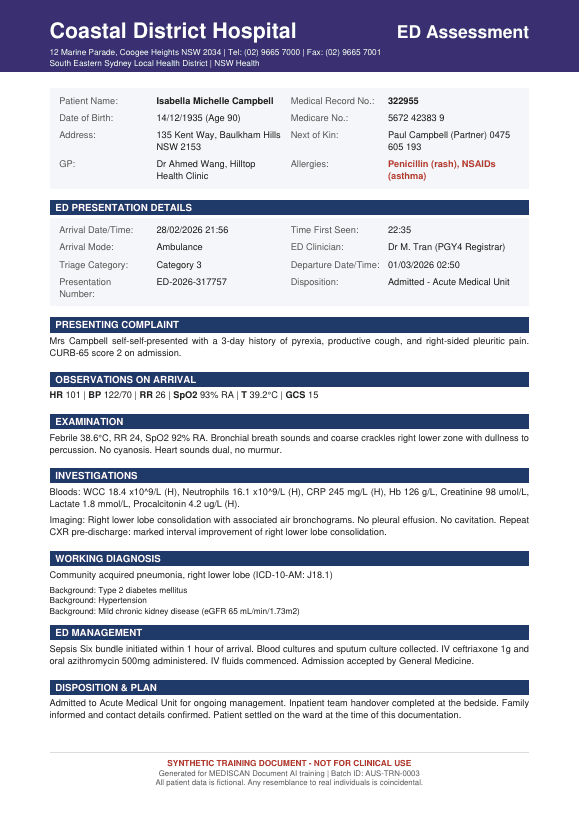
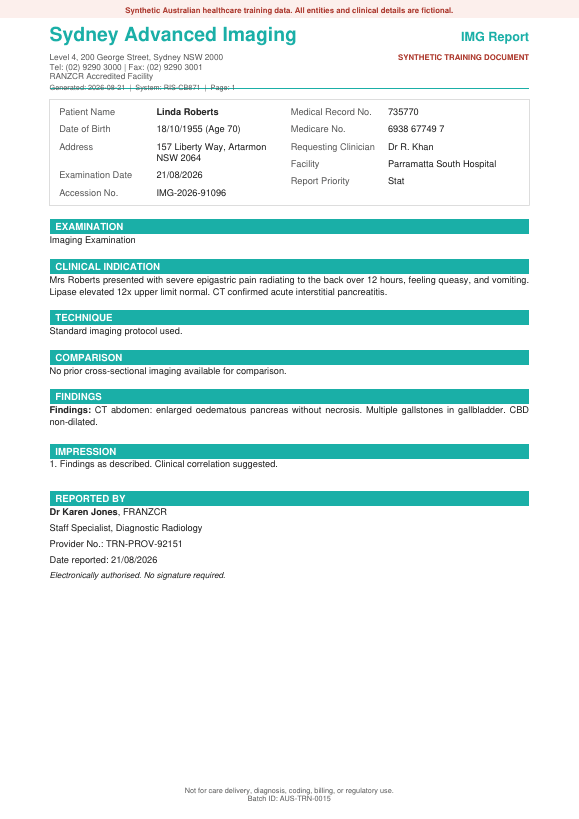
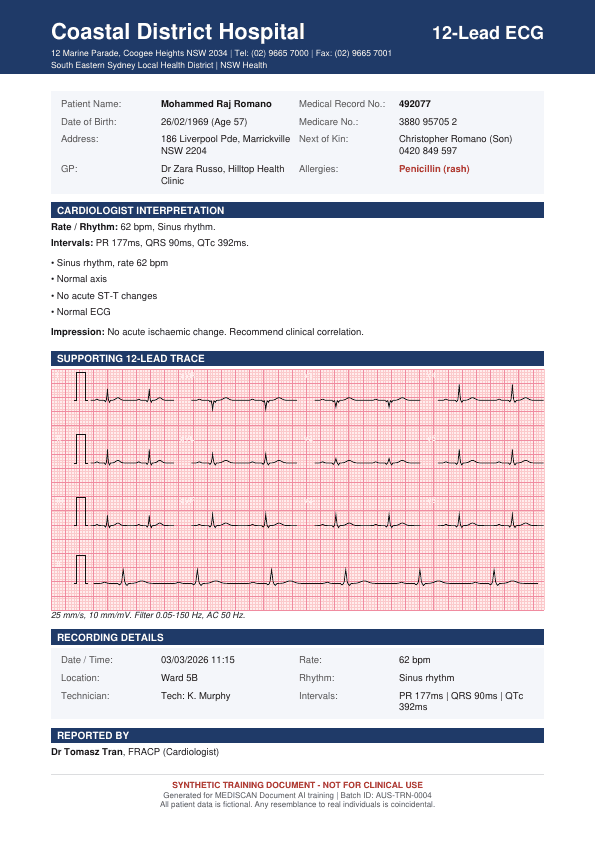
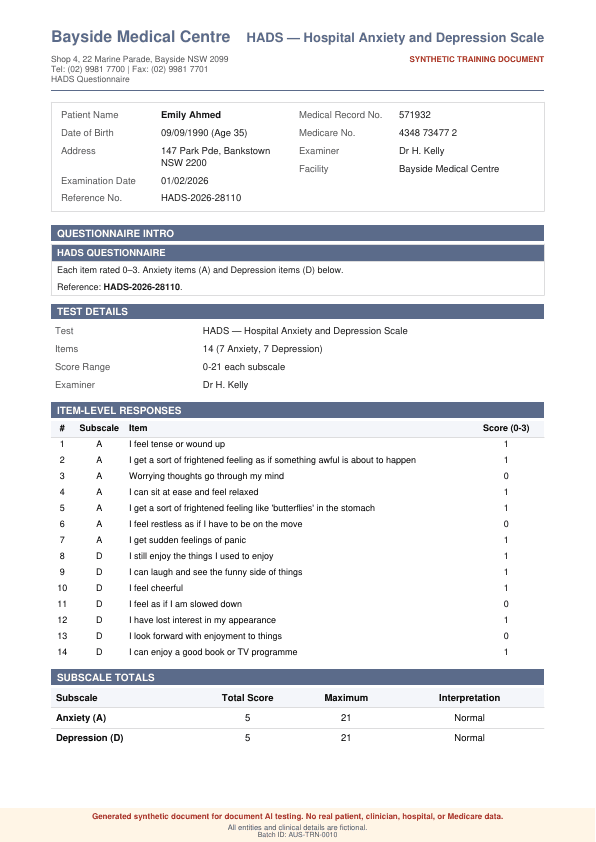
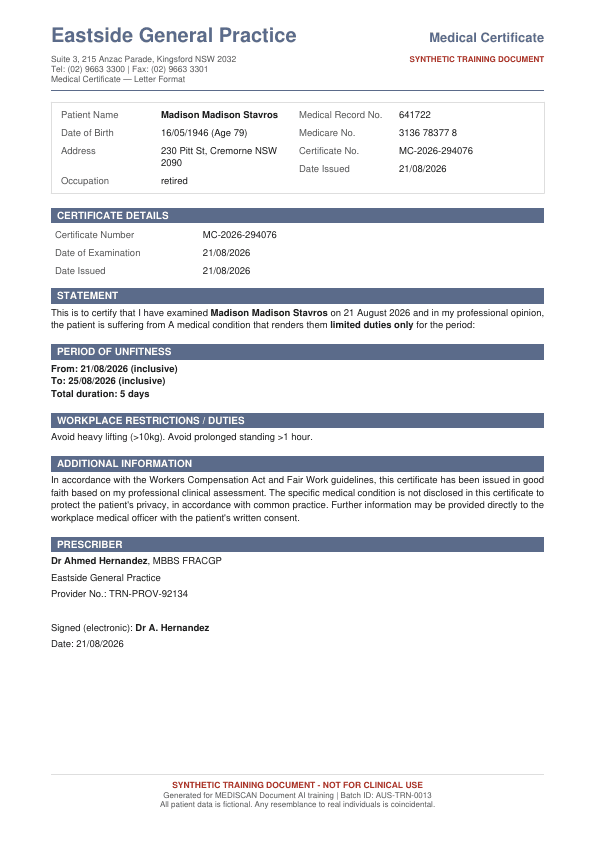
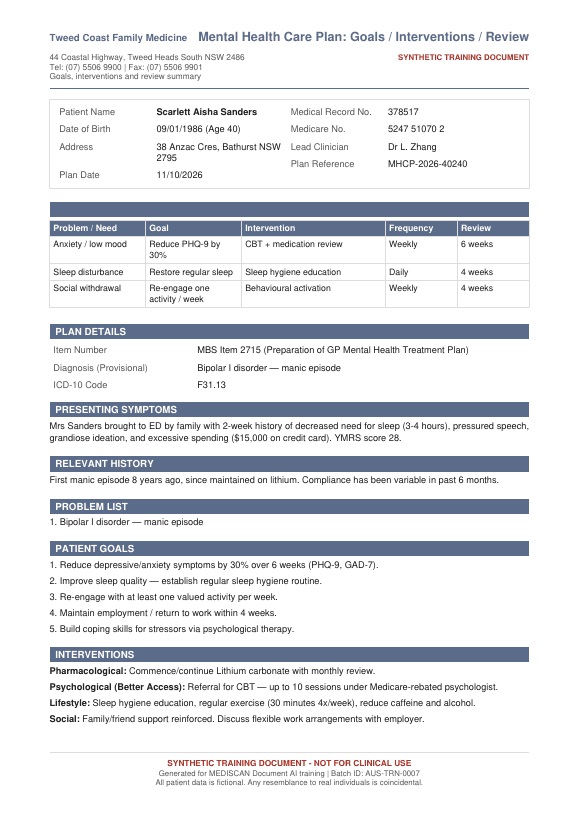
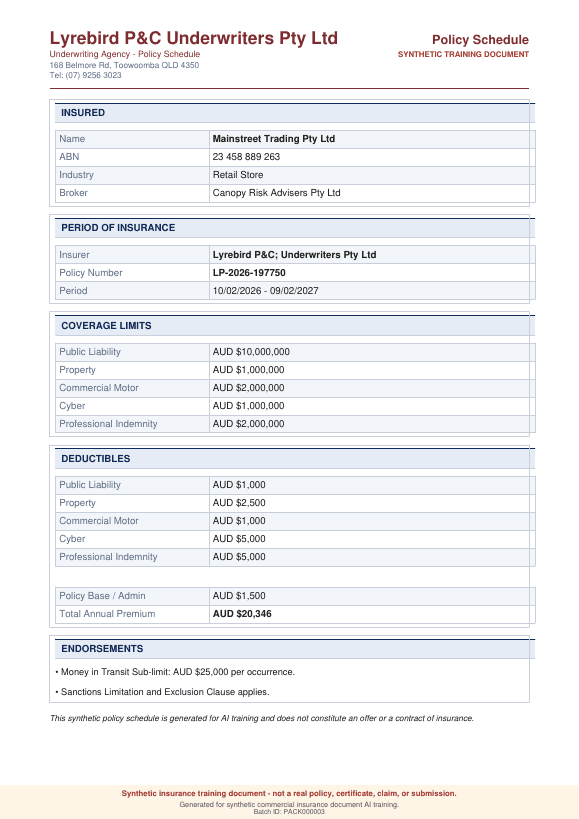
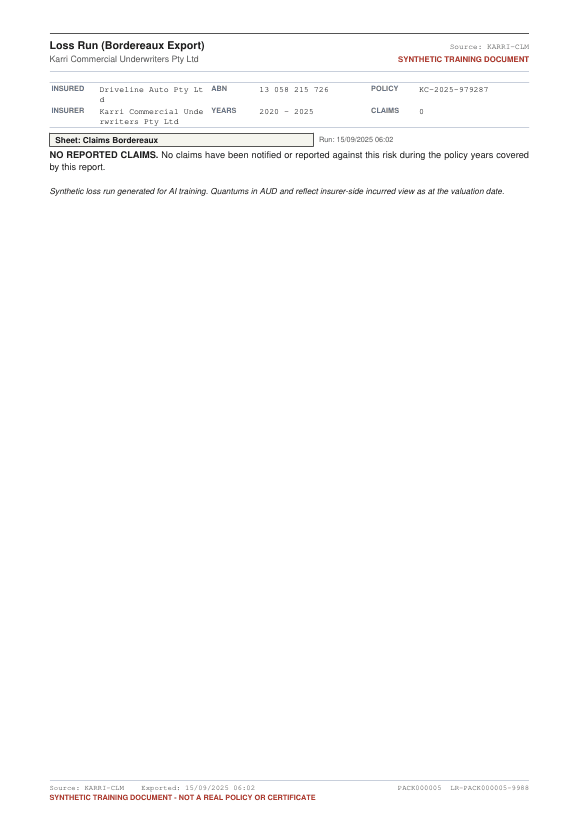
Every specimen above was produced by the RCA engine. No person shown exists. Every page carries a verifiable synthetic disclaimer.
Built for evaluation, not just volume
The engineering- Deterministic by design. Same seed produces byte-identical PDFs and ground truth. Anyone can verify a pack.
- Anti-memorisation variety: 8 style profiles, 3 template families, 4 disclaimer placements, density variation. Your model learns documents, not one template.
- Fully offline and fast. No LLM calls. About 50 documents in 5 seconds, 5,000 in around 5 minutes.
- Australian to the bone: valid Medicare and provider number formats, NSW addresses, local health districts.
- Every page carries a verifiable synthetic disclaimer. Nothing can be mistaken for a real record.
What it costs
Quote-based · anchors published| Tier | What you get | Price |
|---|---|---|
| Free sample | 2 submission packs. Review the schema, the ground truth and the disclaimer in real output. | Free |
| QA Sprint Pack | 10 submission packs, an engineered red-flag summary, and a 30-minute handover call. Built for pipeline QA and vendor evaluation. | AUD $2,500 |
| Production library | 100+ submission packs for a production regression suite or internal QA at scale. | Quote |
| Training library | 1,000+ submission packs with train, validation and test splits for model training. | Quote |
| Tier | What you get | Price |
|---|---|---|
| Free sample | 25 to 35 documents. Review the schema, the Australian conventions and the disclaimer. | Free |
| Pilot pack | 100 to 200 documents scoped to your specialty, for an internal pilot with ground truth. | Quote |
| Production library | 500 to 1,000 documents across 40+ types for a production regression suite. | Quote |
| Training library | 5,000+ documents with train, validation and test splits for model training at scale. | Quote |
Custom libraries are also available: your document types, your field schema, built deterministically and shipped with full ground truth. Tell us what you need to test and we will quote the corpus.
Test on documents that cannot hurt anyone.
Request a preview pack with ground truth included, so your team can evaluate hands-on.